
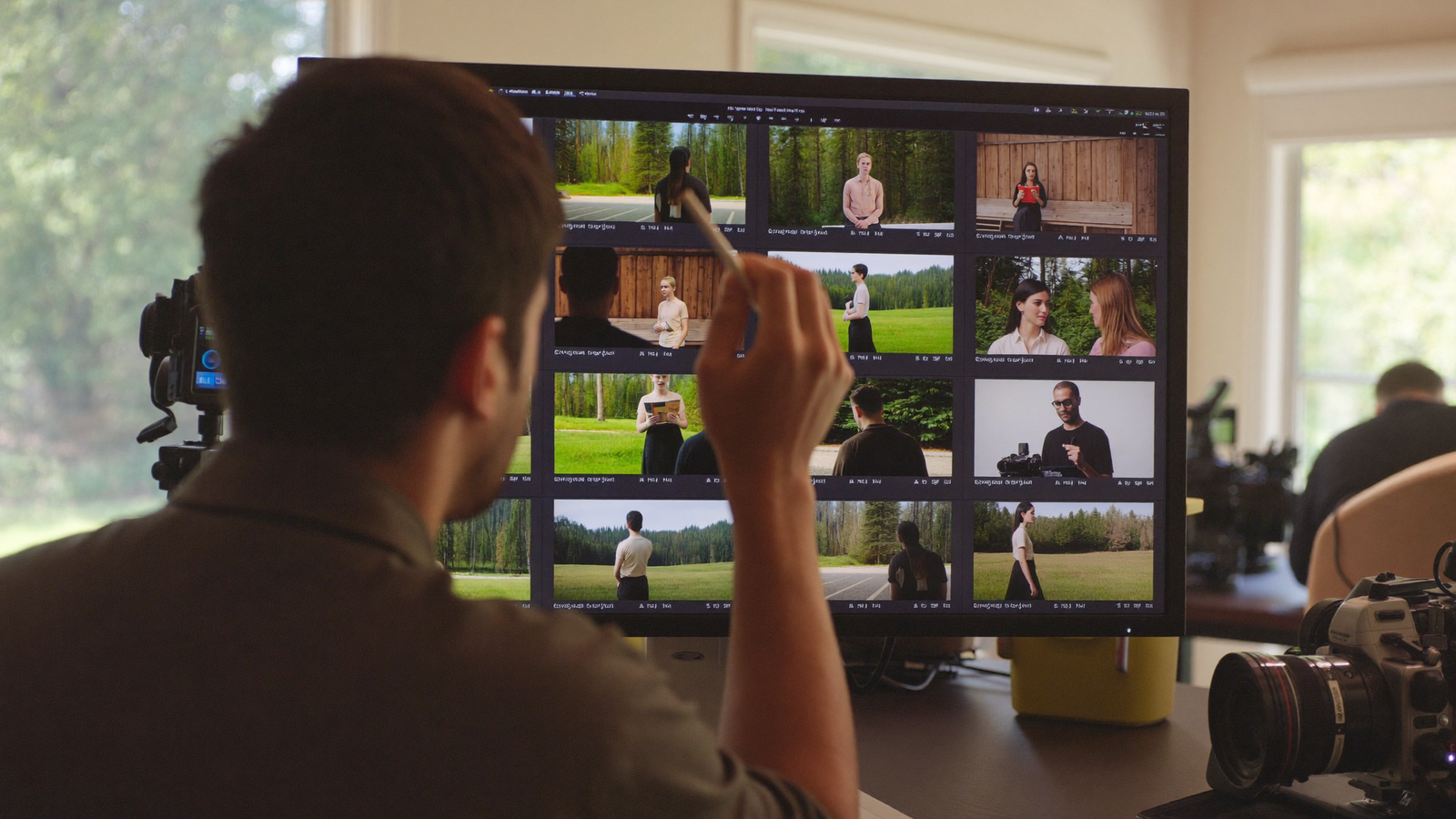
Video podcast editing takes longer than almost anyone expects. If it is slowly consuming your schedule, you are not doing it wrong. You are doing it honestly.
The numbers are unforgiving. A professional podcast editor typically spends two to three times the length of the episode in post-production when aiming for broadcast quality. A Reddit thread on r/podcasting puts it plainly: two hours of editing per episode is standard for quality audio-only work. Add multicam video (syncing cameras, cutting between angles, colour grading, lower thirds, thumbnail design, portrait clips for social) and that figure increases significantly.
One widely circulated content breakdown puts a monthly 30-minute weekly video podcast at 12 to 16 hours of production time, not including strategy, guest coordination, or distribution. That is close to two full working days every month, consumed by editing alone.
Why video editing is different from audio editing
Audio editing is mostly linear: remove the dead air, clean up filler words, fix the levels. A competent editor working from a clean recording can move quickly.
Video editing adds several compounding layers. Multicam synchronisation requires lining up multiple camera angles and audio tracks before a single cut can be made. Visual consistency (stable colour temperature, matched exposures, clean backgrounds) demands review pass by pass. Lower thirds need designing and positioning. Thumbnails are their own production task. And the portrait clips that your marketing team expects for LinkedIn and Instagram are effectively a separate edit of the same material.
For a business producing a weekly episode, these tasks do not compress cleanly into spare hours. They demand sustained attention in a dedicated block. That is why so many business podcasts that start with internal production begin to slip: not because anyone loses interest, but because the editing load competes with everything else in the week.
The hidden cost of in-house editing
The temptation to keep production in-house is understandable. It feels like the cheaper option. In practice, the cost calculation is more complicated.
If a marketing manager or a junior team member is spending eight to ten hours per episode on editing, planning, and publishing, that represents a significant slice of their working week. We Edit Podcasts identify several factors that rarely appear on a budget spreadsheet: burnout from sustained creative overload, inconsistency when that person gets pulled onto other priorities, and the risk that the entire system collapses when they leave the company.
The consistency problem is the most damaging. Audiences tolerate a lot, but they do not tolerate unreliable publishing schedules. A show that publishes on alternate weeks, or skips episodes when the team is stretched, loses momentum that takes months to rebuild. For a B2B show where the podcast is part of a client relationship or thought leadership programme, an inconsistent cadence is more than a content problem. It signals operational disorganisation.
What outsourcing actually involves
Outsourcing video podcast editing does not mean handing over creative control. It means handing over the production tasks that do not require your presence: the sync work, the multicam cut, the colour grade, the graphic templates, the export pipeline.
What remains with you: the conversation itself, the guest relationships, the editorial direction, the topics. These are the parts that only you can do. The parts that any skilled production team can do, and will do faster because it is all they do, are the ones that consume your time disproportionately.
A specialist post-production team has already built the templates, the workflows, the naming conventions, and the quality checks. They do not learn on your episodes. They apply systems that have been refined across dozens of similar projects. That efficiency is invisible to clients but very visible in the output and in the schedule.
When it makes sense to stay in-house
In-house production is a viable option when one of three conditions is met: someone on the team has genuine post-production expertise and capacity to spare; the show is low-frequency (monthly rather than weekly) and the editing demand is manageable in that cadence; or the budget genuinely cannot support external production and the team is willing to invest in learning the craft properly.
The warning sign is when none of these conditions apply but the decision to keep production in-house is still being made, usually because the upfront cost of outsourcing feels significant. The comparison being made in that moment is cost-versus-cost rather than cost-versus-outcome. The right comparison includes what the show looks like in six months: still publishing weekly at broadcast quality, or limping along with a backlog of unedited footage and an exhausted team member.
Building a system that holds
Whether you outsource or keep production in-house, the same principle applies: a video podcast is a system, not a project. The episodes are the output of that system. If the system is unstable (dependent on one person's availability, built on improvised workflows, under-resourced for the volume of work), the output will be unstable too.
The businesses that run effective video podcasts long-term treat production like any other operational function: with defined processes, clear ownership, and enough resource to sustain the cadence. For most of them, that means working with a specialist production partner rather than absorbing the editing burden internally.
The bottom line
Video podcast editing is real work, and it takes real time. The question is not whether it gets done. It is who does it, and at what cost to your team's bandwidth and your show's consistency.
If the editing is already taking more than it should, or if the quality is lower than you want but there is no capacity to improve it, that is a clear signal that the current model is not sustainable. The sooner you build the right system, the easier it is to keep publishing.
If you are producing a video podcast and want to understand what professional post-production could look like for your show, get in touch.