
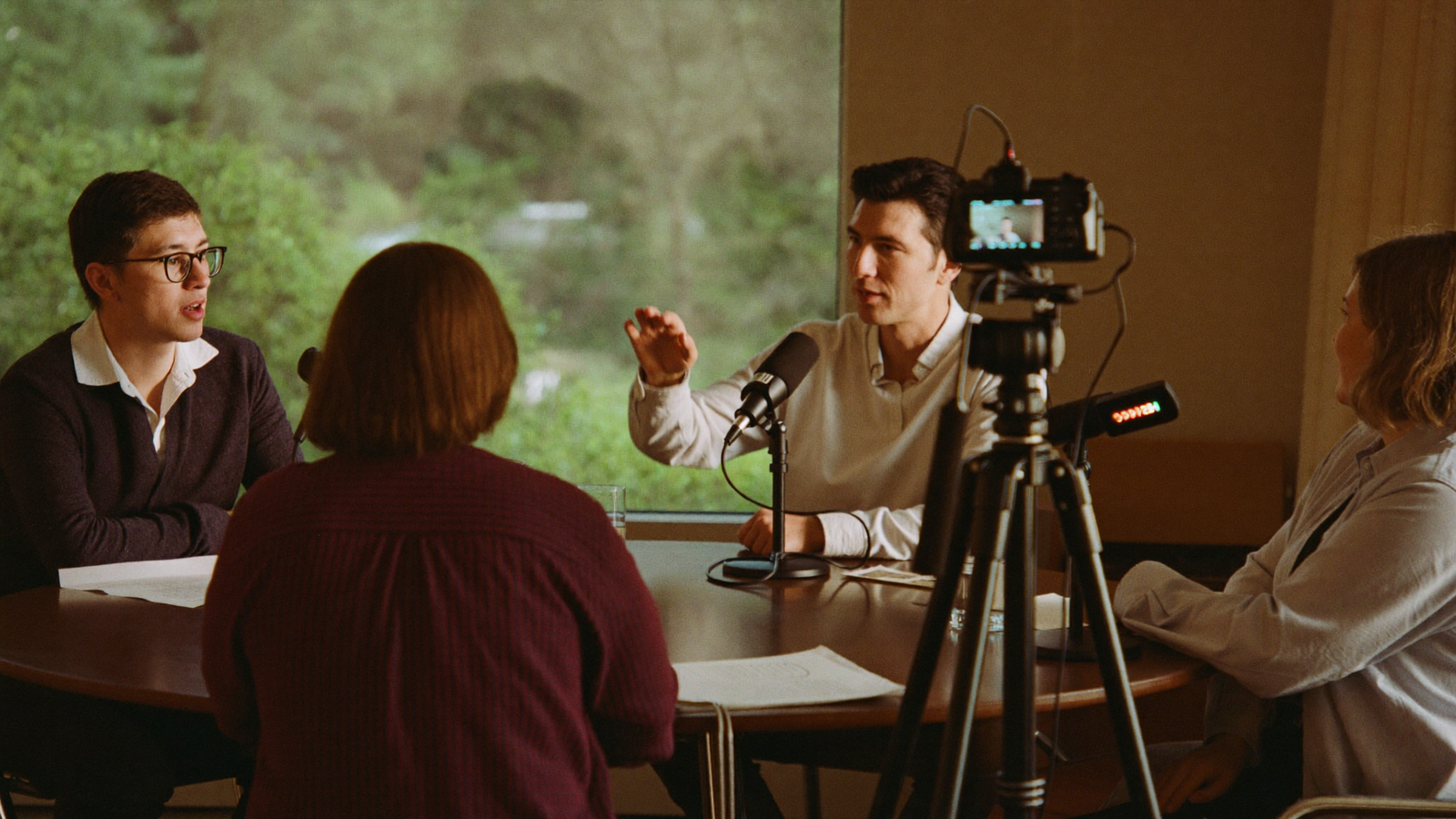
Most of what a trade association or membership body reads about starting a podcast is strategy advice: define your audience, plan your content pillars, build a governance framework for what gets said. Almost none of it addresses the part that actually determines whether members watch the thing. That part is production.
This matters more for an association than for almost any other type of organisation running a podcast. A membership body does not have a captive audience. Members are not employees who have to watch, and they are not prospects being chased down a sales funnel.
They pay a subscription, and they decide, episode by episode, whether the content is worth their time. A show that looks and sounds like it was recorded on a laptop in a spare office does not survive that test for long.
The strategy advice is not wrong, it is just not the gap
Search for association podcast advice and you will mostly find governance content: how to set editorial guidelines, how to align a show with your board's priorities, how to structure a content calendar around your events programme. This is sound advice, and most associations need it.
But it treats production as an afterthought, a technical detail to be sorted once the strategy is settled. For an association specifically, that ordering is backwards.
The UK has somewhere between 180 and 1,350 active trade associations depending on how narrowly you define the category, and Rich Gott of MemberWise puts the wider figure at over 8,000 membership organisations once professional bodies and smaller societies are included. Every one of those organisations is competing for the same finite pool of member attention, much of it now spent on YouTube and LinkedIn rather than in a members' area PDF. A well-governed show with weak production loses that competition before the strategy even gets tested.
Propello Cloud's 2026 membership trends research, based on enterprise membership organisations including several UK bodies, found engagement is the number one priority for 86% of organisations, ahead of acquisition and retention. Yet only a minority have a documented engagement strategy, which means most associations are trying to solve their biggest stated problem without a plan for the content that is supposed to deliver it. A podcast is one of the more credible answers to that problem, but only if the episodes are good enough to hold attention against everything else competing for it.
Membership attention is voluntary, and that changes what production has to do
The clearest evidence for why production quality matters comes from a UK case, not a hypothetical. The Association for Project Management, a chartered body of 28,250 members, built a podcast-style content library specifically because member learning is entirely optional.
Nobody is required to listen. APM's Digital Learning Manager described the core challenge plainly: engagement depends on relevance, perceived value, and ease of access, not obligation.
That is the structural difference between a member podcast and almost every other type of B2B show. A client on a sales call is a captive audience for the length of the call. An employee at a town hall is there because attendance is expected.
A member deciding whether to keep listening to episode four of your show has no such obligation. A broad membership base spanning early-career professionals to senior leaders across multiple sectors makes the content bar higher, not lower. It has to work for people at very different points in their career, on the strength of the content and the experience of consuming it, with nothing else compelling them to stay.
Research on why members do not renew consistently finds "lack of engagement" among the top reasons, cited by 46% of respondents in one recurring annual survey, second only to budget pressure. A podcast is meant to be an engagement lever. One that looks amateurish becomes evidence for the opposite case, that the membership fee is not delivering enough to justify renewal.
The production questions specific to a membership body
A trade association or professional body has production requirements that a typical B2B firm does not, because the content usually has to satisfy several layers of stakeholder before it goes anywhere near a member.
Sign-off runs through committees, not one marketing lead. Episodes touching policy positions, regulatory commentary, or anything resembling the association's official view often need review by a board member, a technical committee, or the chief executive before release. A production partner needs a workflow that accommodates a review cycle with several people in it, not just a single client contact approving a cut.
The show has to represent the whole membership, not one segment of it. A law firm's podcast can comfortably centre its own partners.
An association's podcast usually has to feature a rotating cast of member representatives, sector experts, and sometimes competitors sitting at the same table, because that is the nature of a representative body. Multicam production that treats every guest with the same visual consistency matters more here, because the show's credibility depends on looking evenhanded.
Episodes need a life beyond the feed. Associations use podcast content at AGMs, in conference sessions, in board packs, and in member renewal communications, not just as a standalone show. A finished episode that only exists as a long-form audio or video file is hard to repurpose into the trailer, portrait clips, and thumbnail assets that make it usable across those other channels without a second production pass.
Consistency has to survive turnover in who is speaking. A membership body's spokespeople change: chairs rotate, committee members serve fixed terms, guest experts vary by topic. The production standard, not any one presenter, has to be what makes the show recognisable episode to episode.
None of this is strategy work. It is production infrastructure, and it is the layer most association podcast advice skips over entirely. If you are evaluating who should build it, a podcast production agency that has actually built workflows for multi-stakeholder sign-off and rotating hosts is a different proposition from one that has only produced single-founder B2B shows.
When the decision actually gets made
The same seasonal pattern has now shown up two years running. In September 2025, ASAE published "Why Your Association Should Start a Podcast (and How to Do It Well)". In September 2026, the Virginia Society of Association Executives ran a near-identical webinar, timed to land alongside its Fall Conference & Expo.
That is not a scheduling coincidence. It is Q3 budget and conference season, the point in the calendar when regional association-executive chapters put "should we be podcasting" in front of members, because it is also the point when next year's communications budget gets built.
Most nonprofit and membership-body boards approve their annual budget in the fourth quarter. Governance guidance generally recommends starting that review at least three months before the fiscal year ends, so there is time to reach a final vote.
That timeline matters for a podcast specifically because production lead time, not enthusiasm, is what usually delays a launch. Vetting a partner, scoping a pilot series, and agreeing a committee sign-off workflow takes weeks, not days.
The practical guidance follows directly. If the board approves next year's budget in Q4, the production conversation needs to start now, in Q3, not after the money is confirmed.
That conversation means choosing a partner, running a pilot, and agreeing what sign-off looks like. An association that waits for budget approval before opening it is usually looking at a spring launch at the earliest, well past the point where the year's conference and content calendar was already set.
Why video specifically matters for a membership audience
An association's core asset is its authority on behalf of a sector. Video is what makes that authority visible rather than assumed. A member watching a committee chair discuss a regulatory change on camera gets a different, more credible signal than reading the same point in a newsletter.
That footage also cuts cleanly into the portrait clips associations increasingly need for LinkedIn, where much of the professional audience for this content now spends its attention.
Treating video as the default, rather than an optional add-on to an audio show, is what current member engagement data supports. Engagement is the top priority for the large majority of membership organisations surveyed, and video is the format most directly tied to holding attention once someone starts watching.
The bottom line
An association podcast lives or dies on the same thing every podcast does: whether the content is good enough to keep someone listening who has no obligation to stay. Strategy advice tells you what to talk about. Production is what determines whether anyone sticks around to hear it.
Before choosing a partner, be specific about the production questions above: how they handle committee-level sign-off, how they keep a rotating cast of guests looking consistent, and what a finished episode actually includes beyond the main edit. For a sense of what that full deliverable list should include, see our podcast editing services. Those answers tell you more about likely quality than any strategy deck will.
If you are weighing up what production support your association's podcast actually needs, get in touch.